Harlem Stride Piano
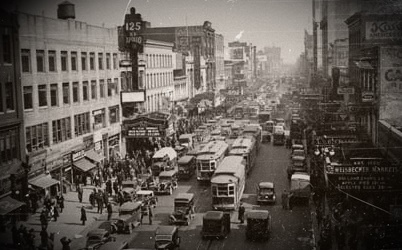 The stride style emerged in Harlem in the late 1910s, at the dawn of jazz. At that time, ragtime was extremely popular, and pianists familiar with the classics of Scott Joplin gradually evolved toward a more open, more flexible music in which the pulse became increasingly syncopated. Richer than its predecessor ragtime, stride offers greater sonic freedom, more flexibility in playing, and relies primarily on improvisation.
This style of playing, self-sufficient and filling the entire sonic space, is also highly visual: the left hand smoothly alternates between bass notes and chords (the word “stride” meaning “to stride”), while the right hand weaves a series of improvisations and variations across the remaining space of the keyboard.
Birth of Stride Piano
By the late 1910s, Harlem had become a musical laboratory. Ragtime, then dominant, provided the rhythmic and harmonic foundation. But each pianist gradually developed a personal language: rhythmically freer, harmonically more expressive, and closer to the blues. The first pianists to practice this style were Luckey Roberts and Eubie Blake, transitional figures between ragtime and early jazz.
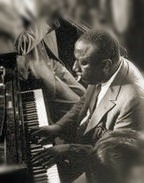
It was, however, James P. Johnson, nicknamed “the Father of Stride Piano,” who standardized and structured these developments. He synthesized the various approaches, established a coherent rhythmic and harmonic vocabulary, and defined the foundations of the stride style. His playing developed a powerful sound, deeply rooted in the blues, with an architectural command of the keyboard. Stride was no longer merely an evolution of ragtime: it had become a language in its own right.
Development and Dissemination
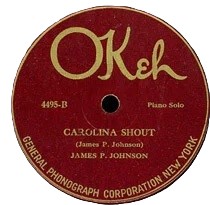 The development of stride is closely linked to the spread of piano rolls. Rolls recorded notably by James P. Johnson and Fats Waller enabled many pianists to study, imitate, and assimilate the style. These mechanical media played a fundamental role: they transmitted not only the notes, but also the rhythmic effects and the energy of the performance.
At the same time, Harlem experienced an extraordinary creative ferment, and nightlife was thriving. The famous rent parties — gatherings organized to help pay the rent — became places of musical confrontation. Pianists would meet there, challenge one another, improvise, and compete in virtuosity.
In this competitive environment, stride quickly grew richer: bolder harmonies, more complex rhythms, increased virtuosity. The style became spectacular and deeply rooted in the urban African American culture of the time.
Stride in Jazz
Stride laid the foundations of modern jazz piano. It introduced:
- a high level of hand independence
- an orchestral approach to the keyboard
- a deep integration of blues and improvisation
The next generation of pianists would be directly influenced by this style. Some would move the piano toward a more streamlined approach, particularly with the development of small swing ensembles, where space had to be shared with other instruments.
Others, on the contrary, pushed stride toward extreme virtuosity. Art Tatum is the most spectacular example: he developed a harmonic language of unprecedented richness and a transcendent technique, extending stride into almost orchestral territories.
Thus, stride played a crucial role in the early years of jazz and forms a bridge between ragtime and modern jazz. Both technical and spectacular, yet deeply expressive, stride paved the way for an entire generation of pianists who left a lasting mark on the history of jazz piano, and it remains today a fundamental school for understanding the evolution of jazz piano and the origins of its modern language.
Characteristics of Stride
The Left-Hand “Pump”
The central element of the style lies in the left-hand playing, commonly referred to as the “pump.” This movement consists of a regular alternation between a bass note — often played as the root or in octaves on the strong beats — and a chord struck on the weak beats. This characteristic “striding” motion creates a powerful, flexible, and dynamic pulse, giving the illusion of a complete rhythm section in which bass and harmony are united under a single hand.
Donald Lambert - Stride piano demonstration
An Orchestral Sound
What truly defines stride, however, goes far beyond the simple alternation between bass and chord in the left hand. The style is based on a global enrichment of pianistic language: chords expand and become denser, harmonic substitutions complicate the discourse, modulations become more frequent, and the entire keyboard is used with great freedom.
Thus, the stride pianist does not merely accompany: he occupies the entire sonic space and gives the impression that a full orchestra resonates beneath his ten fingers.
The Right Hand and the Improvised Language
Meanwhile, the right hand develops its own language based on melodic and harmonic improvisation. It skillfully combines variations, syncopations, and expressive borrowings from the blues. In this context, improvisation is not a simple ornament, but a structural element of the piece. Stride therefore relies on constant creativity, allowing each performance to profoundly transform the original musical material.
Dick Hyman - "With a Little Bit of Luck"
Harlem Stride Piano pianists
- Alex Hill (1906 - 1937)
- Art Tatum (1909 - 1956)
- Claude Bolling (1930 - 2020)
- Cliff Jackson (1902 - 1970)
- Dave McKenna (1930 - 2008)
- Dick Hyman (1927 -)
- Dick Wellstood (1927 - 1987)
- Don Ewell (1916 - 1983)
- Donald Lambert (1904 - 1962)
- Duke Ellington (1899 - 1974)
- Earl Hines (1903 - 1983)
- Erroll Garner (1921 - 1977)
- Eubie Blake (1887 - 1983)
- Fats Waller (1904 - 1943)
- Fletcher Henderson (1897 - 1952)
- François Rilhac (1960 - 1992)
- Herman Chittison (1908 - 1967)
- James P. Johnson (1894 - 1955)
- Jess Stacy (1904 - 1995)
- Joe Sullivan (1906 - 1971)
- Joe Turner (1907–1990)
- Louis Mazetier (1960 -)
- Luckey Roberts (1887 - 1968)
- Mary Lou Williams (1910 - 1981)
- Pat Flowers (1917 - 2000)
- Ralph Sutton (1922 - 2001)
- Teddy Wilson (1912 - 1986)
- Willie "the Lion" Smith (1897 - 1973)